Successful Solutions Professional Development LLC
  • Unit 2 Home Page
    • About Us
    • About the Trainers
    • Blog
    • CDA Credentialing Process
    • CDA Success Stories
    • CDA Course Synopses ​
    • What is a CDA?
  • Enroll Now
  • Student Log-In
  • Contact Us
  • Virtual Classroom
    • Unit 1
    • Unit 2
    • Unit 3
    • Unit 4
    • Unit 5
    • Unit 6
    • Unit 7
    • Unit 8
Sentry Page Protection
Please Wait...
Unit 2 Student Login Unit 2 Student Login Hi, (First Name) Member Area | Log Out
Unit 2 Student Login
Welcome, (First Name)!

Forgot? Show
Log In
Enter Member Area
(Message automatically replaces this text)
OK
My Profile Log Out

(Unit 2) Topic 2: Playdough

2 Clock Hours of Early Childhood Education
Math and Playdough

​Topic 2 Page 13

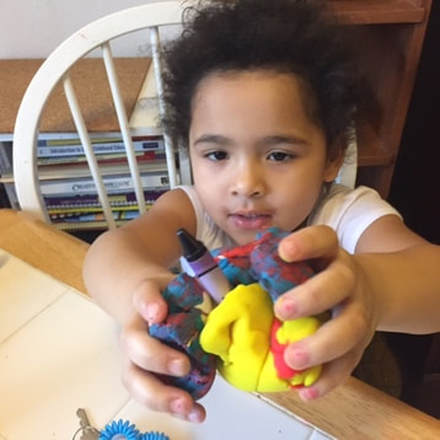
When children play with playdough they are practicing math concepts. Simple mathematical ideas are naturally learned when a child is introduced to playdough. While they may be squishing, building and imagining, they are developing early math and science skills while doing it.​
Spatial Relationships
Spatial relationships are often explored in playdough play. Putting the dough back into its container teaches how much can fit there. Building things on top of, behind, in front or to the side of objects and spaces is an exploration in math concepts that playdough is great for. Children often take a lump of playdough and use it to make objects bigger, wider, or taller. They are experimenting with math concepts while playing with playdough. Developing these spatial relationships directly relates to real-world concepts as children learn about the world around them. 
Picture
Toddlers especially are learning and using spatial relationships. They will pour the contents out of a basket and put them back in, only to pour them out again. Playdough play creates an opportunity to communicate with caregivers and peers about those spatial relationships. “Let’s put the playdough in front of Leo so he can have a turn.” Simple conversations with followed actions benefit a toddler’s developing concept of spatial relationships. ​​​ 
Shapes, Numbers, and Colors
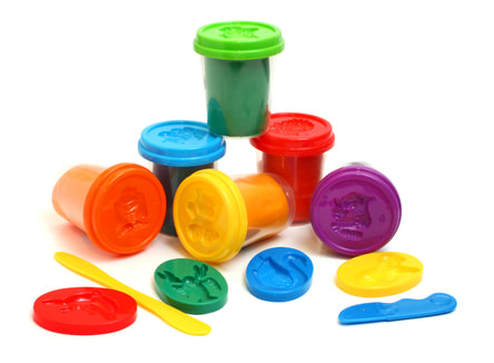
​Playdough usually comes in bright and engaging colors. The very existence of these colors as a play material is giving children exposure to learning colors. The use of colored materials can later lead to advances in sequencing, categorizing and classifying. These are important childhood math skills to develop. 
Picture
​Color coding objects is a simple and fun practice for children when using playdough. Include an assortment of colored objects at the playdough center and encourage children to sort the items by color using the playdough. They can roll out a large lump of clay in one color and imprint the same colored objects onto it. A caregiver can even assist a mobile infant in completing this activity while toddlers can participate on their own. Let groups work together to match the objects with the colors. Extend the learning with older children by teaching color theory and inviting them to match colors from the opposite sides of the color wheel.
​Numbers can be explored with playdough in many ways. Children can count playdough balls, containers, imprints and more. This is an obvious option for including number skills with playdough play but there are more options. Play dough mats or stamps with number shapes on them let children mold the dough to learn the numbers. Counting along with the children during the activities helps to cement the concept that number shapes symbolize an actual number.
​Creating shapes from playdough is a fun and easy option for learning and understanding the characteristics of shapes, angles, volume and dimensions. Even the youngest children can become acquainted with the characteristics of shapes. Invite children to make a shape from playdough using just the dough, toothpicks and dough pieces, cookie cutters, pipe cleaners, scissors and more. Discuss the traits of each shape, pointing out the angles and sides whether equal or not and more. This gives a hands-on approach to shapes and transforms shapes into something tangible. 
Picture
Picture
(Unit 2) Topic 2: Playdough * Navigation Menu
Picture
Picture
Picture
Picture
Picture
Picture
Picture
Picture
Picture
Picture
Picture
Picture
Picture
Picture
Picture
Picture
Picture
Picture
Picture
Picture
Picture
Picture
Picture
Picture
Picture
Picture

Successful Solutions Training in Child Development
Address: PO Box 727, Burley, WA 98322-0727  * www.mycdaclass.com
Copyright 2017.  Successful Solutions Professional Development LLC.  * All Rights Reserved. Updated JULY 1, 2017

Successful Solutions Professional Development LLC BBB Business Review

Enrollment Hours

Monday - Friday          7  am – 8  pm 
Saturday & Sunday     9  am – 8  pm
Holidays                       9  am – 8  pm

Telephone

(360) 602-0960 

Email

[email protected]
Registrations that are submitted after enrollment hours will be processed the next morning.  You will receive an email with your log-in information to access the course within an hour after we open the next business day.
  • Unit 2 Home Page
    • About Us
    • About the Trainers
    • Blog
    • CDA Credentialing Process
    • CDA Success Stories
    • CDA Course Synopses ​
    • What is a CDA?
  • Enroll Now
  • Student Log-In
  • Contact Us
  • Virtual Classroom
    • Unit 1
    • Unit 2
    • Unit 3
    • Unit 4
    • Unit 5
    • Unit 6
    • Unit 7
    • Unit 8