Successful Solutions Professional Development LLC
  • Unit 2 Home Page
    • About Us
    • About the Trainers
    • Blog
    • CDA Credentialing Process
    • CDA Success Stories
    • CDA Course Synopses ​
    • What is a CDA?
  • Enroll Now
  • Student Log-In
  • Contact Us
  • Virtual Classroom
    • Unit 1
    • Unit 2
    • Unit 3
    • Unit 4
    • Unit 5
    • Unit 6
    • Unit 7
    • Unit 8
Sentry Page Protection
Please Wait...
Unit 2 Student Login Unit 2 Student Login Hi, (First Name) Member Area | Log Out
Unit 2 Student Login
Welcome, (First Name)!

Forgot? Show
Log In
Enter Member Area
(Message automatically replaces this text)
OK
My Profile Log Out

(Unit 2) Topic 2: Playdough

2 Clock Hours of Early Childhood Education
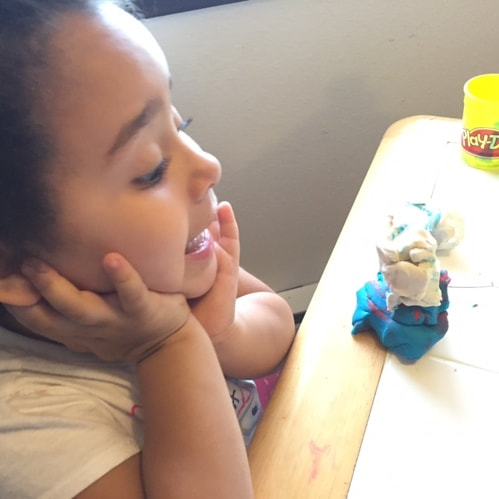
Creative Play and Playdough

Playdough is another vehicle for creative and imaginative play experiences in the classroom. 

​Topic 2 Page 10

Click here to take notes.

Perhaps the most exciting thing about using playdough is that it has endless options for creative play! Toddlers can create and play the same way that adults can. School-age children can use playdough for serious academic purposes such as building STEM-related structures but can also use it as downtime or free play.
​Giving a child a mixture of different colored playdough and allowing them time, space, tools and freedom to create is a powerful learning experience in imagination. Children are free to create whatever they desire and to learn about the different forms that playdough can take. 
​Infants can create shapes and designs in nontraditional ways with playdough by flattening, squeezing and pinching the dough while it is in a sensory bag or presented in another infant-friendly form. Consider combining different colors of dough with other materials to create a sensory bag and encourage infants to trace their fingers through the dough creating lines and shapes and mixing the colors. 
This is a simple early activity in creativity.
​Playdough gives toddlers a great opportunity to be creative in a way that doesn’t require strict plans, materials, methods, or instructions. Often a playdough sculpture of a human will have no arms and 7 eyes, or some other variation that the toddler sees fit. This is perfectly fine and is an exercise in representing certain ideas in the way that works best for the child. Caregivers can encourage this by giving compliments and asking guided questions about their creations.
Picture
​Preschoolers can creatively use playdough to represent characters, themes, settings and more from popular literary works and experiences in the classroom. They can also mold their interpretations of people, places, events and more.

​The preschool classroom is a wonderful place for children to work together to create even further representations of popular themes. Collaborating with peers in creative pursuits gives preschoolers an opportunity to experience pretend play and teamwork. They learn from one another and grow by doing this.
Picture
Picture
(Unit 2) Topic 2: Playdough * Navigation Menu
Picture
Picture
Picture
Picture
Picture
Picture
Picture
Picture
Picture
Picture
Picture
Picture
Picture
Picture
Picture
Picture
Picture
Picture
Picture
Picture
Picture
Picture
Picture
Picture
Picture
Picture

Successful Solutions Training in Child Development
Address: PO Box 727, Burley, WA 98322-0727  * www.mycdaclass.com
Copyright 2017.  Successful Solutions Professional Development LLC.  * All Rights Reserved. Updated JULY 1, 2017

Successful Solutions Professional Development LLC BBB Business Review

Enrollment Hours

Monday - Friday          7  am – 8  pm 
Saturday & Sunday     9  am – 8  pm
Holidays                       9  am – 8  pm

Telephone

(360) 602-0960 

Email

[email protected]
Registrations that are submitted after enrollment hours will be processed the next morning.  You will receive an email with your log-in information to access the course within an hour after we open the next business day.
  • Unit 2 Home Page
    • About Us
    • About the Trainers
    • Blog
    • CDA Credentialing Process
    • CDA Success Stories
    • CDA Course Synopses ​
    • What is a CDA?
  • Enroll Now
  • Student Log-In
  • Contact Us
  • Virtual Classroom
    • Unit 1
    • Unit 2
    • Unit 3
    • Unit 4
    • Unit 5
    • Unit 6
    • Unit 7
    • Unit 8